Эта страница ещё не переведена, поэтому показана на английском.

The art and science of governance

The ideas behind Solon

Nothing here is new, and that is the point. People have been working out how to decide together for thousands of years. Solon is built on what they learned.

01
Athens, c. 594 BC

Solon: laws anyone can read

Solon of Athens, whose name this project borrows, reformed the laws of a city on the edge of civil war. According to ancient sources he freed Athenians who had been enslaved for debt, and he had the laws written on wooden tablets set up in public, where anyone could read them. Then he left the city for ten years, so that nobody could press him to change them.

What Solon takes from it

Rules must be readable by the people they bind — and the person who writes them must be bound by them too.

Our sources on Solon are late and incomplete; historians still debate the details.
02
Switzerland, since 1387

The Landsgemeinde: the whole community in one square

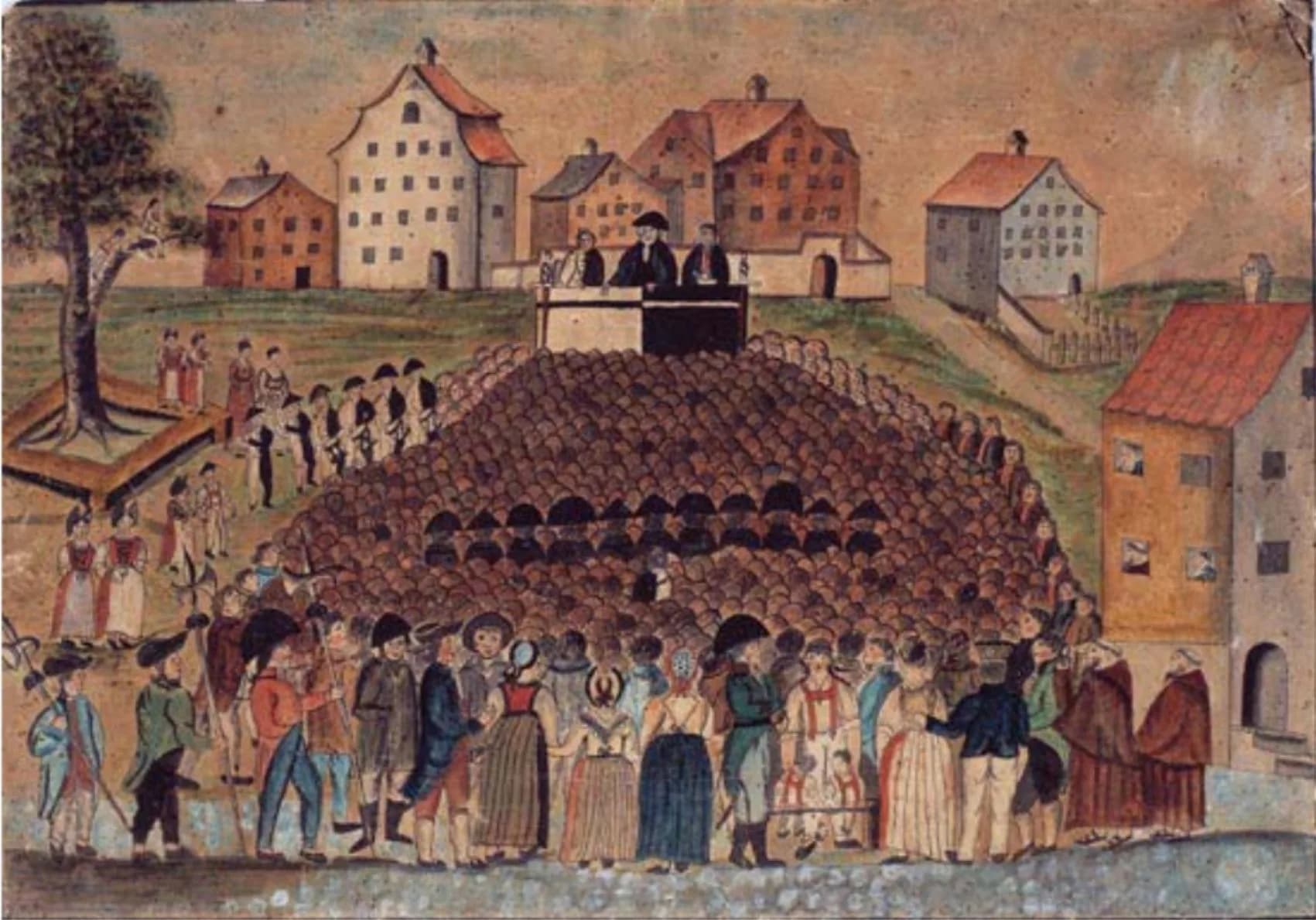
In Glarus, citizens have met in the open air to make their laws since at least 1387. Anyone may speak and propose a change on the day: in 2006 one citizen's amendment from the floor merged twenty-five municipalities into three, going further than the government had proposed. In 2007 Glarus became the first Swiss canton to let sixteen-year-olds vote on cantonal matters.

Appenzell Innerrhoden holds its own assembly on the last Sunday of April, where men may still show a sword instead of a voting card. It is also the warning: its assembly voted down women's right to vote until 1990, when the Federal Supreme Court ruled that excluding women broke the constitution. Women first voted there in 1991.

Картина конца XVIII века: Ландсгемайнде — вся община собралась на площади, должностные лица на помосте над ней.
A Landsgemeinde in the late eighteenth century (Museum Appenzell).
What Solon takes from it

Open assemblies work. And the first question of any group — who counts? — is too important to leave to a simple majority. On Solon, decisions about membership are for people only, and recorded in full.

03
1785 and 1951

Condorcet and Arrow: the count is never neutral

In 1785 the Marquis de Condorcet showed that a group can prefer A to B, B to C and C to A — even when every member's own preferences are perfectly consistent. In 1951 Kenneth Arrow proved that with three or more options no ranked voting rule meets a short list of reasonable fairness conditions all at once.

What Solon takes from it

How you count is a choice, and it changes the result. Solon offers six methods, shows what each one does, and records which one each decision used.

Arrow's theorem concerns ranked methods; score methods fall outside its conditions. It does not mean no vote can be fair.

04
Nobel Prize, 2009

Elinor Ostrom: communities can govern their commons

Elinor Ostrom studied fisheries, forests and irrigation systems that communities had run well for generations, without a state or a market taking over. She found eight design principles they shared: clear boundaries; rules fitted to local conditions; the people affected help make the rules; monitoring; graduated sanctions; ways to resolve conflict; outside recognition of the right to organize; and nested layers for larger systems.

What Solon takes from it

These principles are Solon's checklist: a clear roll of members, rules the group writes and changes itself, a public record anyone can monitor, and — still to build — graduated sanctions, dispute resolution and groups of groups.

Ostrom's own warning: there are no panaceas. Principles, not a recipe.

05
1956 and 1970

Exit and voice

Albert Hirschman observed that members of a failing organization have two responses: leave (exit) or speak up (voice) — and that loyalty delays exit and gives voice time to work. Charles Tiebout modelled people choosing among local governments the way they choose among goods, an idea often summed up as voting with your feet.

What Solon takes from it

Voice needs a place to be heard, and exit needs to stay possible. Solon gives members a vote on the record — and is designed so a member or a whole group can leave with their history.

Tiebout's model assumes people can move freely and at no cost; real life is harder, which is why exit has to be designed for.

06
1860 and 1974

Panarchy and the framework for utopias

In 1860 the Belgian botanist Paul-Émile de Puydt proposed that people should be able to choose their government the way they choose an insurer — without moving house. A century later the philosopher Robert Nozick described the minimal state as "a framework for utopias": a place where people form and leave communities of their own design.

What Solon takes from it

Solon takes no side on which rules are best. It is infrastructure for any rules a group chooses — consensus or majority, assembly or board.

07
2009

Charter cities: new rules need trust

The economist Paul Romer proposed building new cities under new charters — different rules, chosen in advance, that people could opt into by moving there. The early attempts showed how much depends on legitimacy: in Honduras he resigned from the project's transparency commission in 2012 after agreements were signed without it.

What Solon takes from it

New rules only work if the people living under them can see how they are made and enforced. Transparency is not a feature; it is the condition.

08
2022

The network state

Balaji Srinivasan's The Network State describes communities that form online around a shared purpose, organize for collective action, crowdfund land around the world, and seek diplomatic recognition — cloud first, land last.

What Solon takes from it

If communities are going to be founded online, they need governance from their first day: a roll, rules, a record and open books. That is what Solon is.

What Solon takes from all of it

  1. 01

    Rules anyone can read, and change by vote.

  2. 02

    A count the group chose, applied the same way every time.

  3. 03

    A record that only grows, and anyone can check.

  4. 04

    Membership decided by people, never by default.

  5. 05

    The door stays open: you can leave with your history.